
Utility-Scale Deployment
BatteryBarn™: 5 MW / 20 MWh in 6,000 Square Feet
A purpose-built warehouse facility housing 432 CEES™ cartridges. No HVAC. Fire suppression not needed. No augmentation. Where lithium-ion demands 3 to 5 acres of outdoor space, ABC delivers the same capacity in a single 6,000 square-foot building.
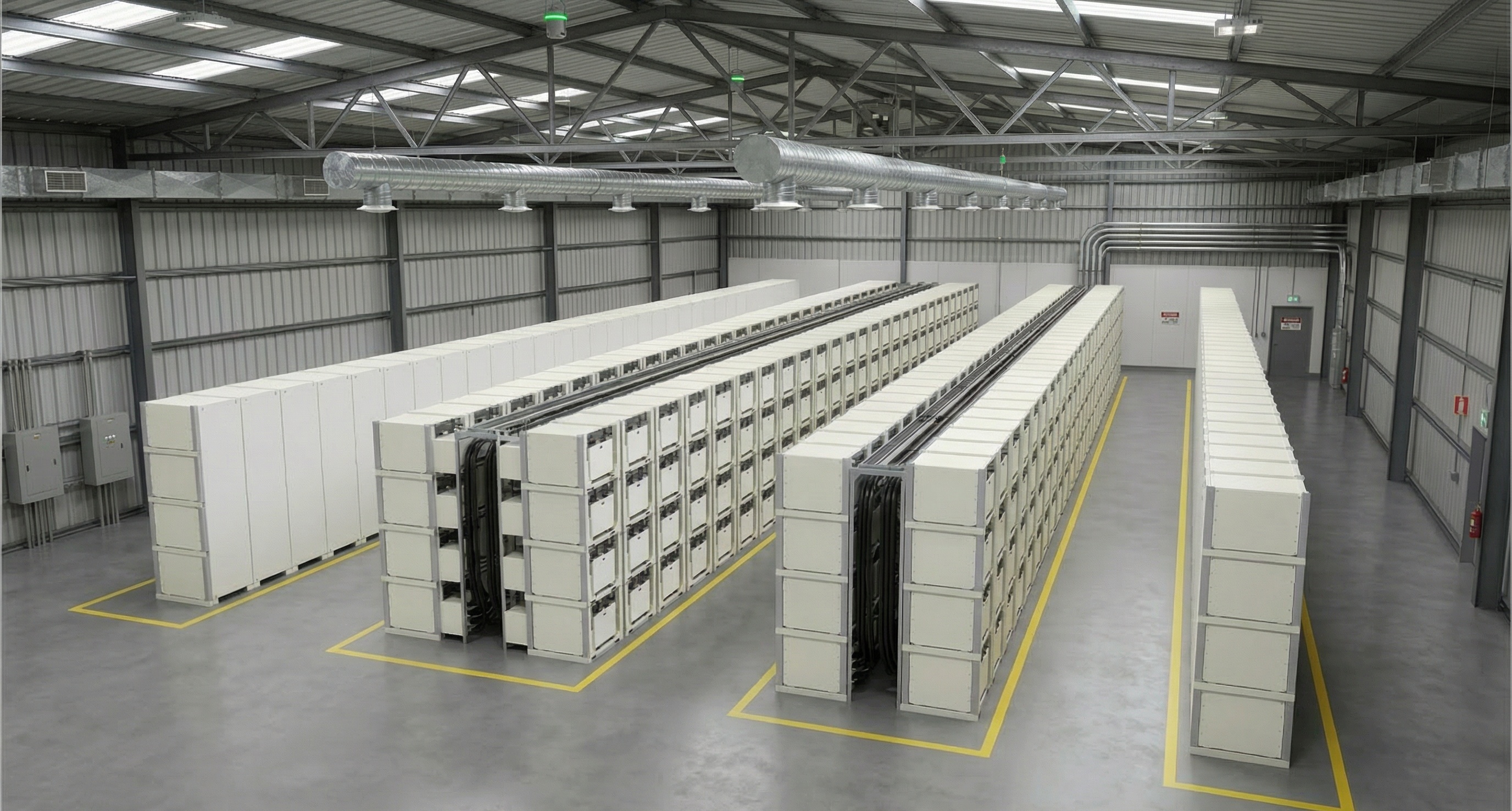
Designed for long-duration performance without the costly augmentation profile required in many large scale lithium-ion deployments
Key Specifications
System Architecture
Cartridge Matrix Configuration
432 CEES™ cartridges arranged in a 4-high by 6-row by 18-column matrix. Each cartridge contains forty-eight 48V bipolar lead modules delivering 48 kWh with flexible nominal voltage options including 48V, 192V, 288V, and 384V. Cartridges are mechanically fastened to adjacent units with a maximum 4-high stack limit per structural analysis.
- DC System Voltage: 1,152V (4 cartridges in series)
- 108 parallel strings for current distribution
- 10-foot row spacing for forklift maintenance access
- High-voltage DC electrical room physically separated from battery area
Restrained Land Resources
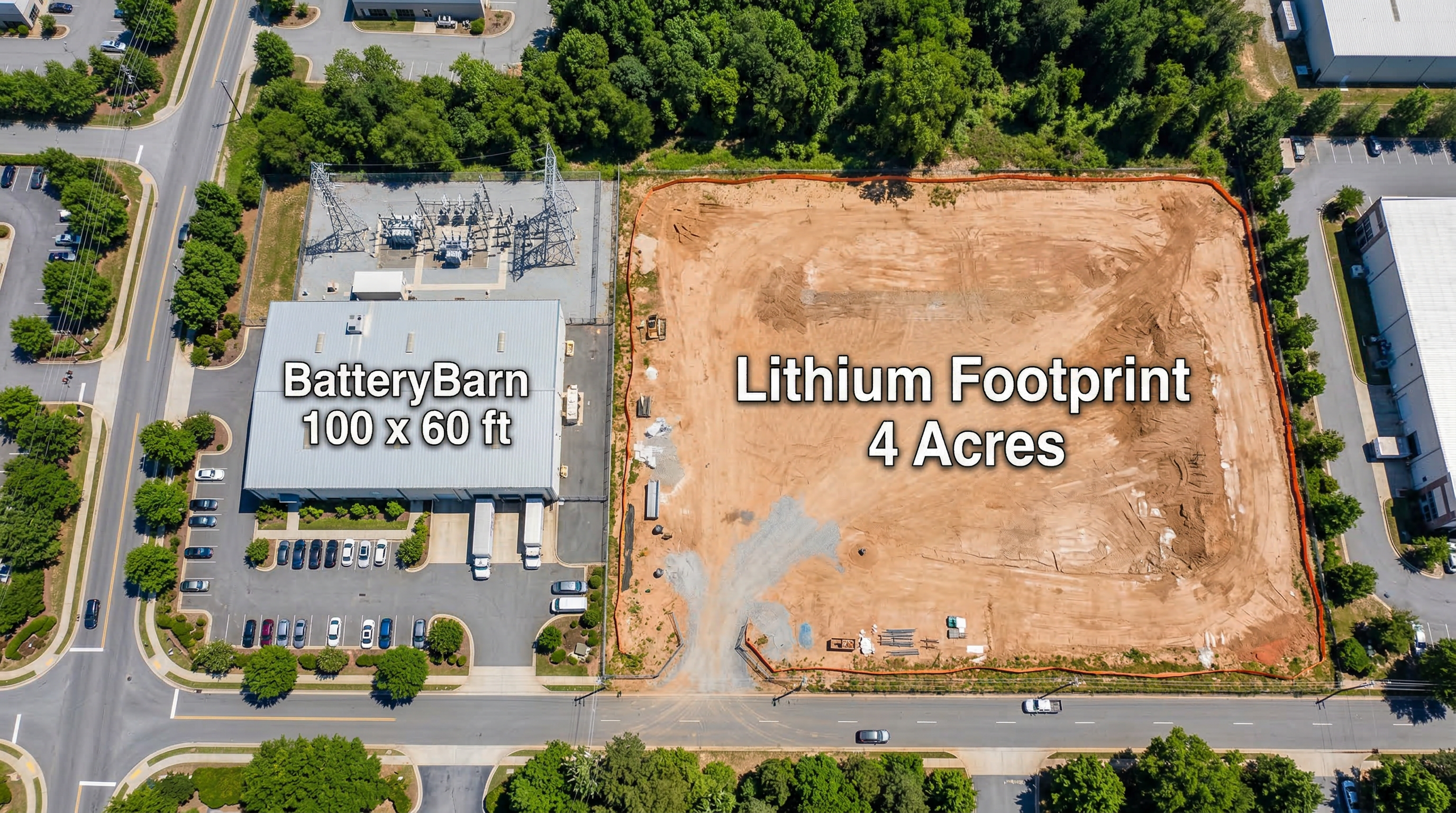
20 MWh on 0.2 Acres. Where Others Need 3 to 5.
Land is the constraint that kills most utility-scale storage projects. Permitting delays, environmental setbacks, community opposition, and real estate costs all scale with acreage. The ABC BatteryBarn eliminates this bottleneck entirely. 20 MWh consolidates into a single 6,000 sq ft commercial building that can be sited directly adjacent to the substation, on existing industrial parcels, or in urban infill locations where 3 to 5 acres of lithium-ion pad space simply does not exist. No fire suppression setbacks. No blast-rated exclusion zones. No HVAC equipment yards. The result is a deployment that fits where others cannot.
Revisiting the World's Largest Battery with Bipolar Lead Technology
In 1988, Southern California Edison commissioned the largest electrochemical energy storage facility ever built at the time, a 10 MW / 40 MWh flooded lead-acid installation that proved grid-scale battery storage was technically viable. The project pushed lead-acid technology to its limits, identifying key failure modes. ABC took these lessons and used them to design a better battery, a GreenSeal® bipolar lead battery. Every root cause of the Chino facility's retirement can be traced to the inherent limitations of conventional flooded lead-acid cell construction. ABC's GreenSeal® bipolar lead battery architecture directly addresses each of these failure modes.
Safety and Compliance
No HVAC. Fire Suppression Not Needed. No Compromise.
Non-Flammable Chemistry
- Aqueous sulfuric acid electrolyte absorbed in AGM separators
- No organic solvent
- No flammable liquid
- Zero fire propagation risk
- Eliminates NFPA 855 thermal barrier and explosion venting requirements
Zero Thermal Runaway
- Lead-acid electrochemistry does not support exothermic thermal runaway
- The battery cannot self-heat to ignition
- Eliminates the catastrophic failure mode that drives prescriptive requirements for lithium-ion installations
Standard Construction
- Deploys in standard commercial warehouse structures
- No explosion-rated construction, no fire-rated separation walls, no active suppression systems
- Reduces construction cost and accelerates permitting timelines
Hydrogen Management
- Sealed VRLA design with flame arrestors on every vent port
- Continuous mechanical ventilation maintains hydrogen below 1.0% by volume, well below the 4.0% lower flammability limit
Performance
Verified Performance Specifications
| Parameter | Specification |
|---|---|
| Round-Trip Efficiency (AC-AC) | 88% |
| Response Time | Less than 1 second |
| Depth of Discharge | 0 to 100% |
| Maximum Daily Cycles | 1 (deep cycle) |
| Maximum Annual Cycles | 360 |
| Annual Degradation | Less than 0.1% per year |
| Capacity Fade | Less than 0.1%/yr, no measurable fade over design life |
| Design Life | 20-25 years |
| Daily Cycle Life Warranty | 15 years |
| Augmentation Required | None |
| Recyclability | 100%, positive residual value at end of life |
Total Cost of Ownership
20-Year Cost Advantage
$0 Augmentation
Lithium-ion systems require battery augmentation every 7 to 10 years to maintain rated capacity. ABC's less than 0.1% annual degradation eliminates this entirely. Zero augmentation cost over 20 years.
$0 HVAC and Fire Suppression
No chillers. No heaters. Active fire suppression systems not needed. No annual maintenance contracts for climate control or suppression equipment. These avoided costs compound over the life of the project.
Get Started
Evaluate BatteryBarn™ for Your Project
Our engineering team will assess your site requirements, load profile, and interconnection constraints to determine if a BatteryBarn deployment is the right fit.