
Skip to content
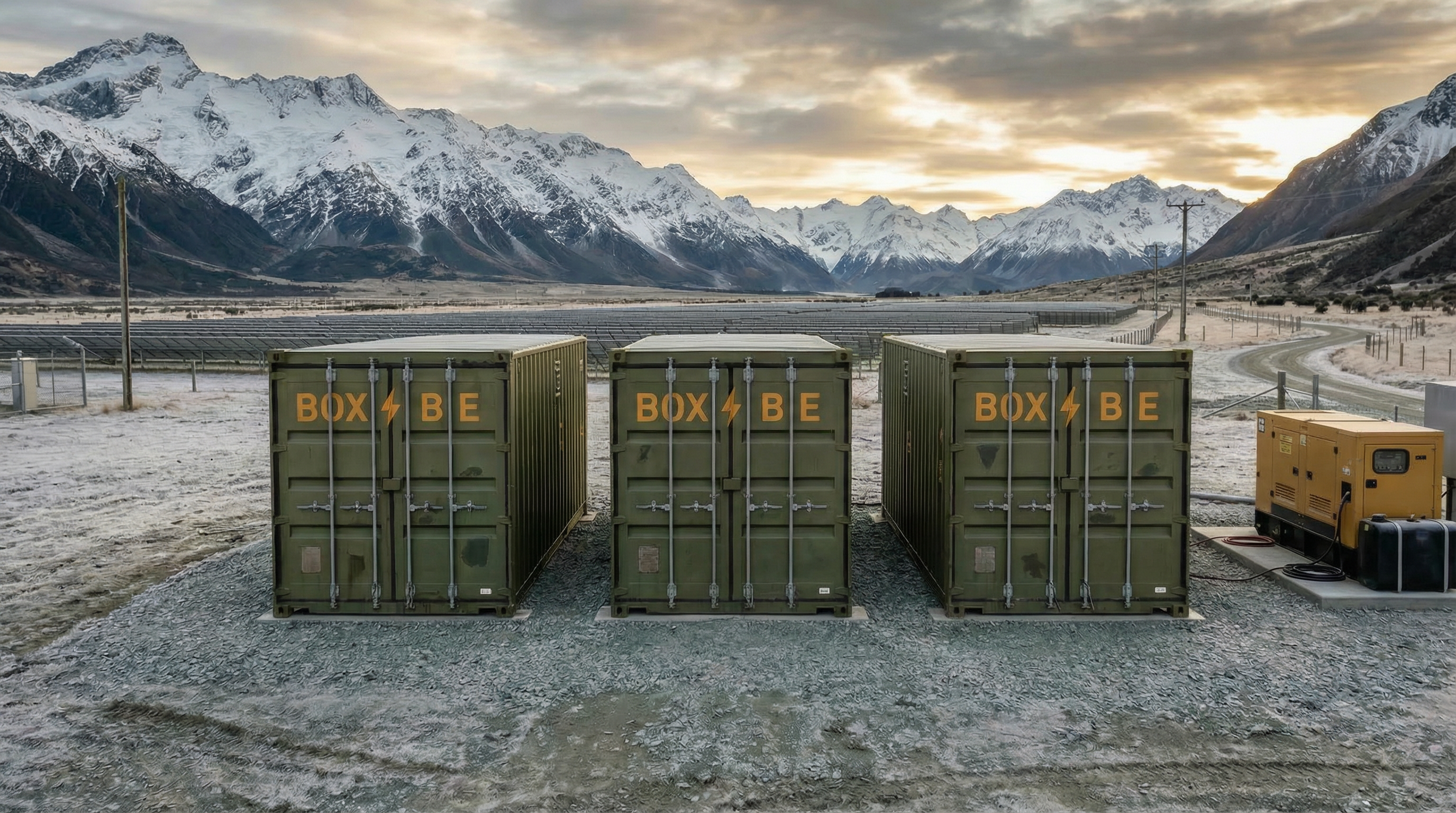
Three BoxBe 10-foot containers in cold mountain valley, all doors closed with amber BOXBE signage, solar field and diesel generator

Engineered for Extreme Environments

ABC's bipolar architecture is fundamentally different from conventional battery design. Instead of scaling consumer-grade chemistry, we engineered a platform from the ground up for large-format, mission-critical energy storage where fire risk, extreme temperatures, and environmental exposure are operating conditions, not edge cases.

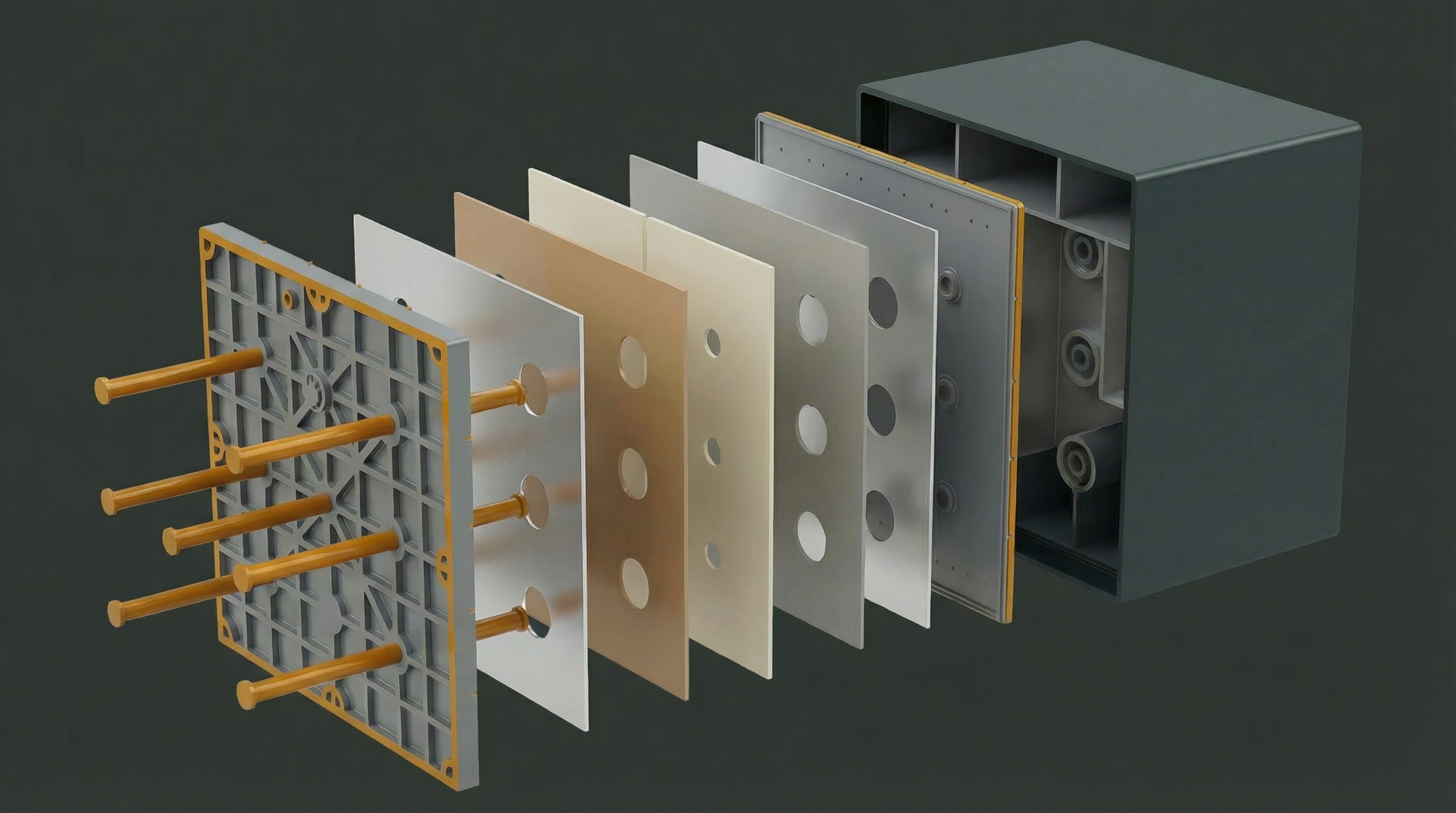
GreenSeal bipolar lead battery cell exploded view on dark slate background
85+ Patents. Zero Thermal Runaway. 15-Year Daily Cycle Life Warranty.

The Core Building Block

Every ABC deployment starts with the CEES™ cartridge. One modular unit that scales from kilowatts to megawatts.
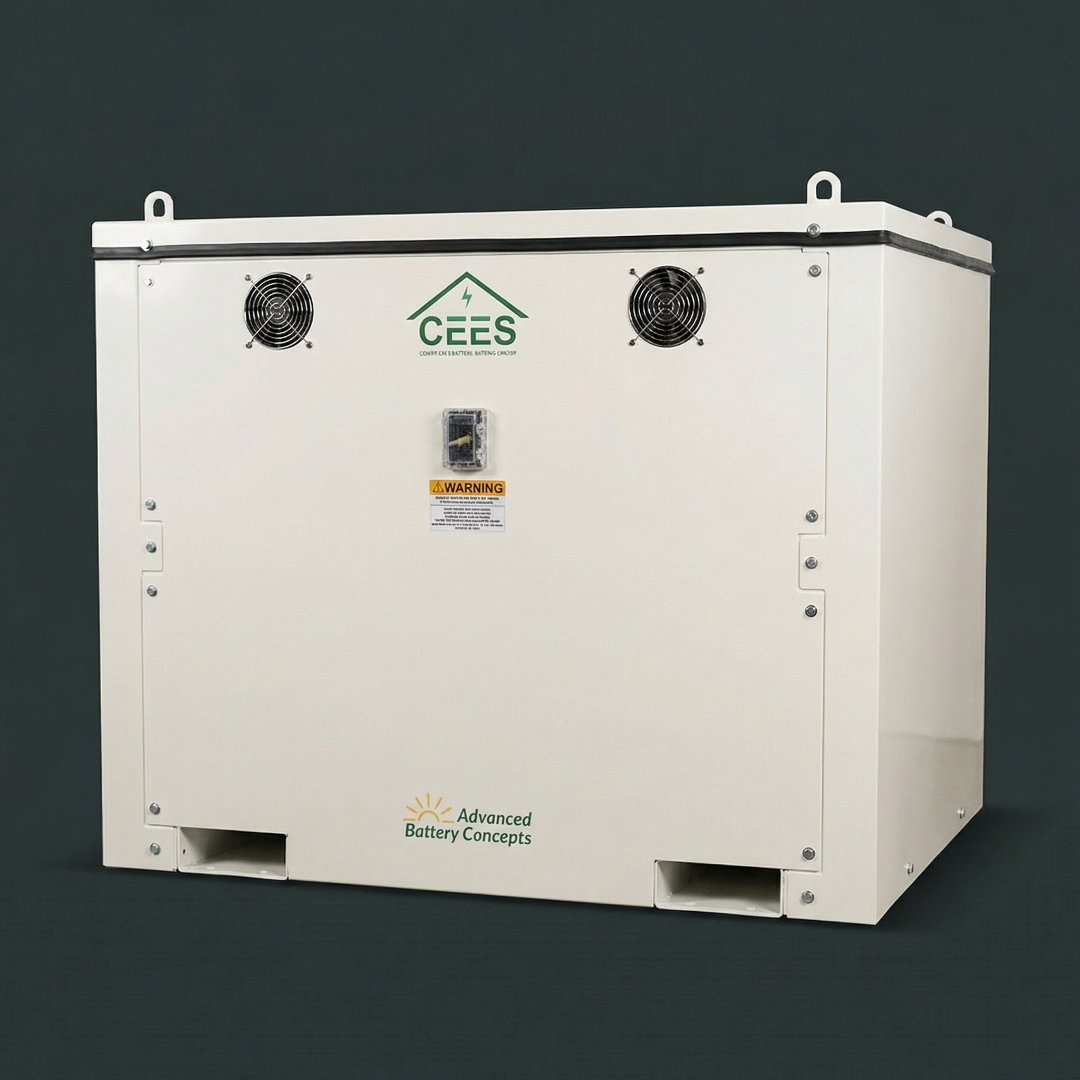
CEES 48 kWh cartridge squared front view with green CEES logo, cooling fans, and Advanced Battery Concepts branding

CEES™ 48 kWh Cartridge

The CEES™ cartridge is a near-cube steel enclosure housing forty-eight 48V bipolar lead modules. 52.3 inches long, 45.8 inches wide, 80 inches tall. 3,550 lbs. IP55/NEMA3R rated. Deploys indoors or outdoors with zero HVAC and zero climate control. Fire suppression not needed. Stackable up to 4 units high.

Backed by a 15-year daily cycle life warranty with zero augmentation required. 20-25 year design life with majority of microgrid use cases.

48 kWh
Energy capacity per CEES™ cartridge. Flexible Nominal Voltage options including 48V, 192V, 288V, and 384V, from forty-eight 48V bipolar lead modules.
-40 to 55 C
Ambient operating temperature range with no HVAC, no heaters, no chillers required at any point.
Zero
Thermal runaway events. Aqueous electrolyte chemistry makes thermal runaway physically impossible.
IP55 / NEMA3R
Environmental protection rating. Indoor or outdoor deployment. UL 1973 certified, UN 2800 classified.
Less than 0.1%/yr
Annual capacity degradation. No measurable fade over the 20-25 year design life.
15-Year
Daily cycle life warranty on current GC battery. Zero augmentation required.
20-25 Year
Design life with majority of microgrid use cases.
3,550 lbs
Unit weight. 52.3 inches long, 45.8 inches wide, 80 inches high. Stackable up to 4 units high.

Bipolar Architecture Advantage

How Bipolar Lead Differs

Traditional monopolar batteries connect cells externally using heavy bus bars and complex wiring. Each cell is a separate unit, leading to uneven current distribution, wasted space, and increased resistance. ABC's bipolar architecture stacks cells internally. Each electrode serves as both the positive plate of one cell and the negative plate of the next.

This design eliminates intercell connections, reduces internal resistance, and creates a compact, high-voltage module that outperforms monopolar designs in every metric that matters for critical infrastructure.

  • Uniform current density across the entire electrode surface
  • Higher energy density through elimination of intercell hardware
  • Simpler BMS requirements due to inherent cell balancing
  • Lower manufacturing cost via automated stacking processes
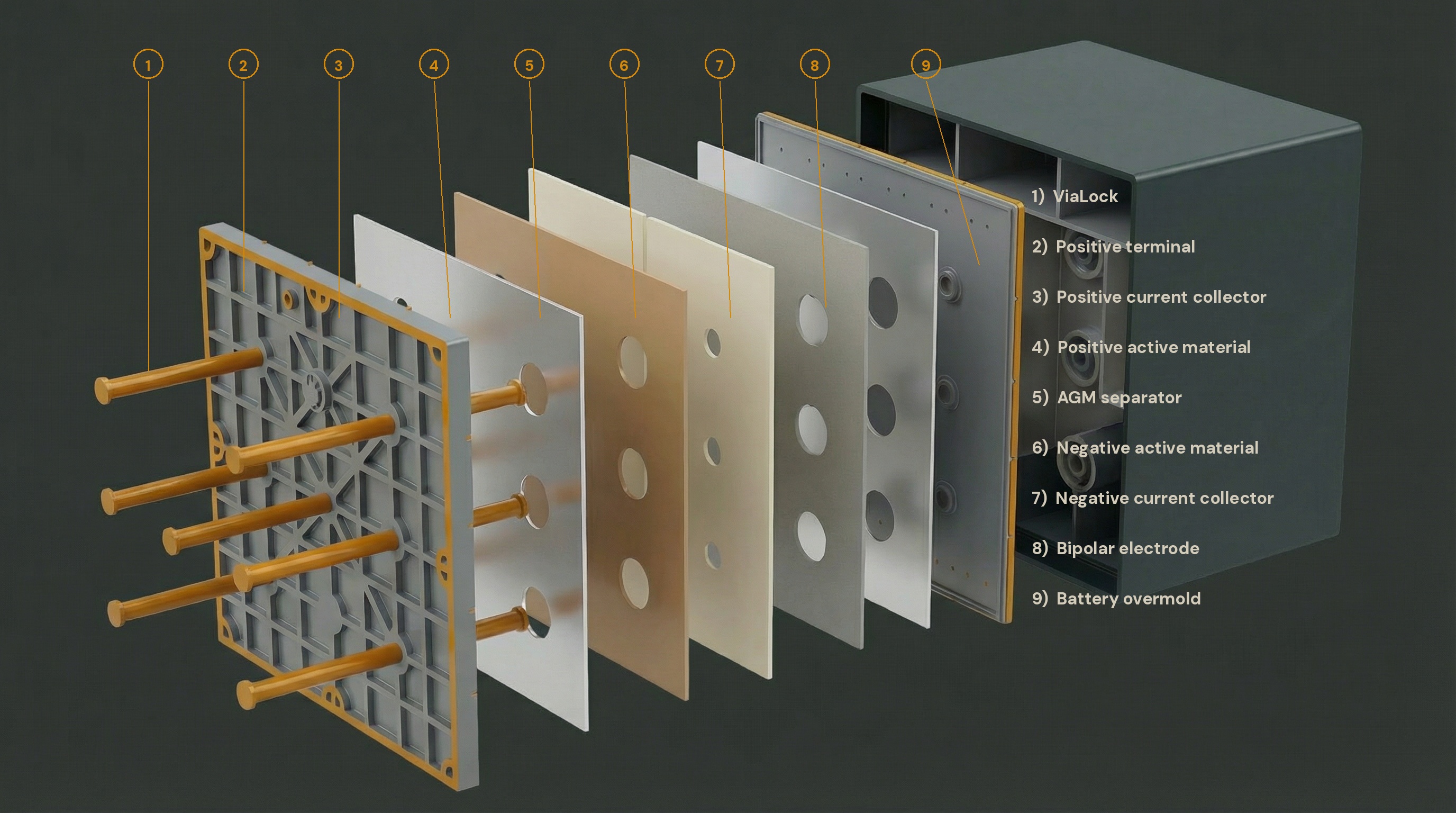
GreenSeal bipolar lead battery cell exploded view with ViaLock rods, plates, AGM separators, and cubical casing on dark slate background
GreenSeal bipolar cell labeled exploded view with 9 components identified

Protected by 85+ Patents Worldwide

Every layer of ABC's technology stack is protected intellectual property, from the cell architecture to the manufacturing process.

Platform / GreenSeal

GreenSeal®

  • ABC's original bipolar lead battery platform
  • Validated across thousands of cycles and multiple deployment environments
  • The foundation for all ABC products

Sealing / ViaLock

ViaLock®

  • Proprietary cell-to-cell sealing technology
  • Creates hermetic seals between bipolar cells that withstand extreme temperature cycling, mechanical stress, and decades of electrochemical activity

Manufacturing / RapidFill

RapidFill™

  • Proprietary electrolyte filling process ensuring consistent, void-free fills across every cell in the bipolar stack
  • Essential to manufacturing quality and throughput

Lead-Acid Battery: 167 Years of Powering the World

1859
Gaston Planté invents the lead-acid battery in France, the world's first rechargeable battery
1881
Camille Faure develops the pasted-plate design, enabling mass production
1901
Electric Storage Battery Company (now Exide) founded; industrial-scale manufacturing begins
1910s
Adopted for automotive starting, lighting, and ignition (SLI), fueling the automobile revolution
1970s
Sealed valve-regulated (VRLA) batteries emerge, eliminating maintenance and expanding use into telecom, UPS, and data centers
2025
Global market valued at ~$102 billion; underpins automotive, grid backup, telecom infrastructure, and renewable energy storage across every continent
Today
U.S. recycling rates approach 99%; lead-acid remains the most circular battery technology on Earth, still essential to global energy resilience

From 48 kWh to 20 MWh

48 kWh / Single Unit

Single CEES™ Cartridge

One CEES™ cartridge for residential backup, small commercial, or remote monitoring stations.

384 to 768 kWh / BoxBe Container

BoxBe Container

8 to 16 CEES™ cartridges in 10-foot or 20-foot ISO containers. Pre-integrated, pre-tested, transport ready.

20 MWh / BatteryBarn

BatteryBarn™

432 CEES™ cartridges in a 6,000 sq ft warehouse. 5 MW AC output. 4-hour duration. The largest deployment configuration.

See How ABC Technology Fits Your Project